
When sourcing dovetail drawers, it’s critical to work with a reliable manufacturing partner so you...
Sustainability requirements are becoming a more common part of cabinet and millwork specifications—especially for commercial, institutional, and high-end projects. Universities, corporate facilities, government buildings, and medical environments may require FSC®-certified materials as part of broader green building standards.
For cabinetmakers and architects, that can raise an understandable question: Does choosing FSC®-certified material mean compromising on drawer quality, appearance, durability, or cost?
With the right material and construction, the answer is no.
CCF’s FSC®-certified Maple mix provides a responsible-sourcing option for projects that require certified material without sacrificing the strength, consistency, and finished quality expected from a well-built drawer box. A FSC® certification is about where and how the wood is sourced, not about lowering the performance standard of the material itself.
For customers who need to meet green building requirements, FSC®-certified materials makes it possible to specify sustainable drawer components while maintaining the same practical focus on construction, application, and value.
What Does FSC Mix Mean?
 FSC® Mix material includes a blend of material from FSC (Forest Stewardship Council)-certified forests, recycled sources, and controlled wood. It offers a flexible and cost-effective way to support responsible forest management while giving project teams an option that aligns with sustainability requirements.
At CCF, Maple is currently the available FSC®-certified material option.
This is especially relevant for projects where material sourcing is part of the specification. Architects, cabinetmakers, designers, and commercial millwork teams may need to document that specific products support a project’s green building goals. In some cases, FSC®-certified material is preferred. In others, it may be mandated by the building owner, architect, institution, or project standard.
FSC Mix Maple allows those requirements to be addressed without treating the drawer box as an afterthought.
Certification Does Not Change How the Drawer Performs
The performance of a drawer box comes down to the same core considerations it always has: material selection, side thickness, bottom thickness, joinery, dimensions, anticipated load, and how the drawer will be used.
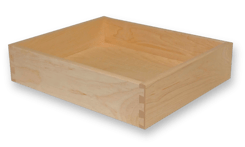 A FSC® certification does not make a drawer weaker, less durable, or less refined. It verifies the sourcing of the material within the FSC chain of custody. The Maple itself can still be specified and built around the demands of the application.
That matters for projects where the finished cabinetry has to do more than look good. Drawers in commercial, institutional, and medical spaces may be opened and closed throughout the day, used by many people, and expected to hold up over the long term. They need to feel substantial, operate reliably, and support the overall quality of the installation.
FSC®-certified materials give project teams a way to meet material-sourcing requirements while still making decisions based on real-world performance.
A drawer built with FSC®-certified materials can be configured with the same attention to construction as any other drawer. It can be designed around the load it will carry, the size of the opening, the type of slide hardware, the preferred joinery, and the level of finish expected by the customer.
In other words, sustainability and performance do not have to compete.
Build to the Application
No two drawer applications are exactly alike. A drawer installed in a private residence does not face the same demands as one in a university residence hall, corporate office, government facility, healthcare setting, or high-end hospitality environment.
That is why construction should always begin with the job.
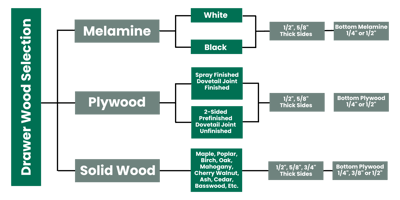
CCF offers FSC® Mix Maple in available side material thicknesses of 1/2", 5/8", and 3/4". These options give cabinetmakers and project teams the flexibility to choose a construction that fits the expected use of the drawer.
A lighter-duty drawer may not need the same material thickness as a large drawer that will hold heavier contents or see frequent use. For more demanding applications, a thicker side material can provide a more substantial feel and support the long-term durability the project requires.
Bottom material is available in 1/4" or 1/2" thicknesses, allowing the drawer bottom to be matched to anticipated loads and use. A drawer storing lightweight personal items may call for a different construction than one used for files, equipment, supplies, or other heavier materials.
The key is to select the right combination of material and construction, not to automatically choose the most expensive configuration or the lowest-cost option.
A Strong Fit for Specification-Driven Projects
FSC® Mix Maple is an especially valuable option for projects where responsible sourcing is a defined part of the work.
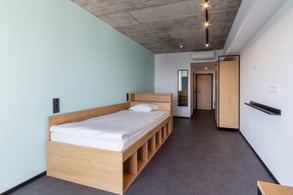 Universities, corporate buildings, and government facilities often include sustainability criteria in their construction or renovation requirements. Medical and institutional projects may also have detailed specifications that guide material selection. In these environments, project teams may need to balance green building goals with demanding expectations for durability, consistency, appearance, and cost.
Our FSC®-certified Maple gives architects and cabinetmakers a drawer material option that supports those conversations.
For an architect, it can help meet a project requirement without compromising the intended design. For a cabinetmaker, it provides a material choice that can be discussed confidently with commercial clients and general contractors. For a building owner or facilities team, it helps align the cabinetry package with larger sustainability objectives.
And because the material can be specified in different side and bottom thicknesses, the drawer box can still be built around the practical needs of the space.
Sustainable Sourcing Should Not Mean Settling
The best drawer specification considers more than one goal at a time.
It should meet the expected level of use. It should fit the design and appearance of the cabinetry. It should support the project budget. And when applicable, it should help meet sustainability and material-sourcing requirements.
Rather than viewing certified material as a compromise, project teams can treat it as a purposeful specification choice—one that supports responsible sourcing while still delivering the quality and performance CCF customers expect.
For high-end commercial, institutional, medical, corporate, university, and government projects, that can make FSC®-certified Maple a valuable part of the drawer construction conversation.
Talk to CCF Early in the Process
 The best time to discuss FSC®-certified materials is early in the process, before specifications are finalized and production is underway.
By bringing CCF into the conversation early, cabinetmakers, architects, and project teams can review the application, required material documentation, drawer dimensions, construction preferences, thickness requirements, and project budget together.
That makes it easier to choose a drawer solution that supports both the performance of the finished cabinetry and the sustainability goals behind the project.